Showing posts with label weblog. Show all posts

200 Alzheimer's Patients now being implanted with Microchip


Florida-based VeriChip has developed an FDA-approved microchip that can be implanted in an Alzheimer's patient's arm. The VeriChip contains a unique 16-digit number which allows for wearer identification and immediate access to that persons medical record. The medical information is contained in a database managed by VeriChip and could be accessed from a hospital emergency room. The microchip about the size of a grain of rice must be scanned in order for the information to become available. The chip is being positioned by VeriChip as a critical part of emergency medicine. It is obvious that the majority of early adopters are interested in the chip for wandering and identification of lost loved one’s.

One disadvantage of the chip is that it must be read by a scanner and they are not readily available to law enforcement or outside a hospital. Another disadvantage is that the chip is not clearly visible. In order for a wearer to be identified they would need to be taken to a hospital. The chip does allow for immediate access to medical records and this is certainly an advantage in situations were immediate medical treatment is necessary.

In comparison to the chip, the Alzheimer’s Association offers a low-tech alternative, the Safe Return bracelet. The Safe Return bracelet contains a toll free 800 number that allows for fast identification of the wearer. The bracelet which cost $40 is an inexpensive alternative. Most law enforcement personnel can identify the bracelet on sight.

The microchip is “riling" up privacy advocates because it allows for immediate assess to private medical records. The security of the VeriChip scanner/reader is an issue. Who will have access and is the system secure?

My feeling is that the majority of families directly involved with Alzheimer’s disease would favor the chip if it were cheap and as effective as the bracelet in identifying lost or wandering loved one's. It is my belief that privacy advocates should stay out of the way of the development of the system and allow the families involved to make decisions concerning their use of the chip.

VeriChip based in Delray Beach, Florida intends to implant the chip in 200 volunteers in the next week. There are more then 250,000 people suffering from Alzheimer’s in south Florida.


Forty Dollar Alzheimer's Association Safe Return Bracelet Saves Life

Safe Return Bracelet

Wikipedia, VeriChip

VERICHIP CORPORATION AND ALZHEIMER’S COMMUNITY CARE OFFICIALLY LAUNCH VERIMED PATIENT IDENTIFICATION PROJECT ON AUGUST 28

ABC News Alzheimer's Patients Lining Up for Microchip


Caring for the Caregivers


“I don’t think I know how to handle the situation with dementia,” she said about her husband’s disease, diagnosed 10 years ago. “I lose my temper a lot and I get exasperated. I know I’m not handling things well, not for him and not for myself.”

Probing Question


Most of us have had the experience of forgetting where we've parked our car or have struggled to recall an acquaintance's name. But once we hit our 50s, said James R. Connor, these incidents might cause us to worry that we're showing early signs of Alzheimer's disease.


Source Penn State Live
Penn State Research

By Melissa Beattie-Moss
Research Penn State

Most of us have had the experience of forgetting where we've parked our car or have struggled to recall an acquaintance's name. But once we hit our 50s, said James R. Connor, these incidents might cause us to worry that we're showing early signs of Alzheimer's disease.

Fortunately, that's not usually the case, says Connor, professor of neurosurgery in Penn State's College of Medicine, Penn State Hershey Medical Center. "If forgetting something now and then was a good indicator of dementia, we'd all be in trouble," he added with a laugh.

This dreaded condition was first classified as a disease 100 years ago by German psychiatrist Alois Alzheimer and is the "leading cause of dementia in the elderly," explained Connor. In fact, four million Americans now suffer from this progressive disease, including up to 50 percent of seniors over age 85 and up to 15 percent of those over 65.

The aging of baby boomers will swell those numbers in the coming years. "At the present time, Alzheimer's disease (AD) costs the nation $100 billion a year, with an average $174,000 lifetime cost per patient," Connor said. "By the year 2050, there will be an estimated 14 million Americans with the disease. The human and economic toll is devastating, so it's imperative that we learn more about prevention, early diagnosis and treatment."

Is it possible to prevent Alzheimer's? For those who already have signs of persistent memory decline, there are some neurosurgical procedures and therapeutic drugs available that may help slow the disease's ravages, Connor noted. But for the millions of "worried well," science has not yet found any definitive ways to prevent the disease.

Although recent research suggests that genes may play a role in contracting the disease, "the No. 1 risk factor for Alzheimer's is aging," said Connor. "You have to live long enough to develop this disease," which researchers believe to be caused, in part, by a sticky protein called "amyloid plaque" that accumulates on brain cells, disrupting the transmission of their signals. "Neurofibrillary tangles" -- protein threads that strangle and eventually kill nerve cells -- are also present in the brains of AD patients. "If we have a computer with cables that are broken and tangled, it won't work right, and it's the same with our brains," added Connor.

Scientists speculate that the protein coatings and tangles within the brain could be the body's inflammatory response to long-term toxin exposure, as well as damage from "free radicals," unstable molecules that attack and harm the body's cells by stealing their electrons through a process called oxidation.

Although some studies suggest that anti-inflammatory drugs (including common painkillers such as ibuprofen and naproxen) may help to dissolve amyloid plaques, "we need to proceed with caution in this area," Connor believes. One paradox of the disease, he says, is that "there may be a positive function to the plaques. They may be the body's way of sealing off leaky blood vessels in the brain."

Many researchers believe that metals (chiefly iron, copper and zinc) may play a role in Alzheimer's, since these substances are abundant within the folds of plaque in diseased brains. When free radicals bump into metal atoms in the body, they unleash a chain reaction that can wreak havoc on healthy cells, prematurely aging them and potentially leading to a variety of serious health conditions. MRIs and autopsies of patients with advanced Alzheimer's often reveal massive iron accumulation, Connor noted.

Although excess metals may damage the brain, he adds, another paradox is that small amounts of these micronutrients are absolutely essential to healthy brain function.

Research on the exact link between metals and memory processing is inconclusive at this point. "Is there too much copper or too little in the brains of AD patients? Studies are unclear," Connor remarked. So, too, is the role of zinc, he added. Though there's high zinc content in the healthy hippocampus -- the part of the brain responsible for short-term memory -- the jury is still out on the connection, so there's no reason to recommend zinc supplements at this point. Too much might cause a problem as well. It's all about the right balance.

Nor should one completely avoid dietary iron or copper, suggested Connor, although some physicians recommend "decreasing your iron burden" through occasional blood donation, particularly for men and post-menopausal women, who are at higher risk for accumulating iron and for developing neurodegenerative diseases.

Other recommendations made by some physicians (particularly for patients noticing subtle cognitive decline) include taking antioxidants such as vitamins E and C, going for chelation therapy and making dietary changes.

"Remember," said Connor, "that if you flip the statistics, at least half of those over 85 don't have Alzheimer's. In addition to studying those with the disease, we're also studying seniors with good short-term memories, looking for predictors of healthy neurocognitive aging."

***

James R. Connor is professor and vice chair in the department of neurosurgery at the Penn State College of Medicine, available at jrc3@psu.edu via e-mail. This feature is based on a lecture given by Connor on Jan. 27 at University Park as the first of the 2007 Penn State Lectures on the Frontiers of Science.

For more Probing Questions and other features about research at Penn State, subscribe to Research Penn State at http://www.rps.psu.edu/cgi-bin/subscribe.cgi online.


Wishing each and every one of you a Happy, Healthy New Year


Dorothy after having too much fun over Christmas.

Bobby and Dorothy wish everyone a Healthy, Happy New Year!


My Mother


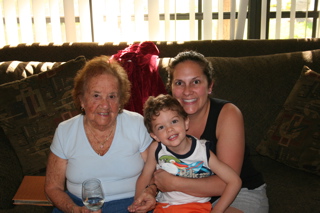
This is a picture of my mother Dorothy who is 90 years young, Kristen my mother's granddaughter, and Ryan her greatgrandson.

This picture was taken at the Banana Boat in Boyton Beach Florida, May, 2006.


Why Didn't I Get It?


The signs were there but no one could see them--not even me.


Why Didn't I Get It?

I was talking to my sister one evening and she said to me, “You better call Mom she says she hasn’t talked to you in months.” I laughed and said I talked to her two days ago and for more than an hour. Later in the evening, I decided to call my mother. After she recognized my voice she said, “Well its about time you called.” When I said I just talked to you two days ago she just shrugged it off and we began our usual conversation.
I really don’t know why I wasn’t more concerned at the time but to be honest I wasn’t. And neither was anyone else. The typical comment, “she sounds good to me.” I guess like most people I just accepted the fact that she was getting old. Nobody saw a problem not even her friends who saw her on a daily basis.
Looking back there were plenty of signs. For one thing, she was developing a very negative attitude. But, it seemed when I spent time with her, a few days, she would turn back into her normal self and start to have a more positive outlook on things. Another sign occurred when she began to scrape her feet as she walked. I suppose I should have concluded something but I didn’t. We thought she was finally slowing down. I could go on and on.
Then Christmas came and I decided to take her shopping. To my surprise she could barely walk for five minutes without stopping. In fact, she was almost slumping over. Out of the clear blue sky, or so it seemed, she just couldn’t walk any distance and it was struggle just getting her back to the car. Clearly something was a-muck.
I went to talk to her doctor. Other than her high blood pressure, her heart was fine and her overall blood work was pretty good—more than pretty good for a woman her age. Keep in mind we are talking about an 87 year old woman at the time, a woman who had never had a major illness or operation her entire life. The closest she had come to any of that was when she had an operation on a bunion on her foot.
Yet now for some reason she was no longer able to walk comfortably. I began to notice how she was somewhat unsteady, how she began to reach out and hold on to things as she walked, and how she no longer had an interest in doing anything that required her to walk. Two years earlier this woman, my mother, walked more than a mile round trip with me in New York to eat breakfast.

My Mother the Dynamo


She lived on her own, paid her own bills, and took care of herself.......


My mother at the age of 85 was a dynamo.
She lived on her own, paid her own bills, and took care of herself. She had been doing this for more than ten years since the death of my father. She was on her own.

My mother was often spotted walking to the pool in her community. A tiny women the senior citizens all around her marveled. It seemed as if father time had forgotten about her. There was no limit to what she could do. Walk 20 blocks, no problem, you name it. Up at dawn and awake at midnight she was a real dynamo.

My mother was very funny, a real character. She made people laugh and smile. She read the paper and watched CNN, she had opinion on everything and wanted to know your opinion. She was a wonderful person: always welcoming people into her home. She was noted for all of my 50 years for her great Italian cooking. I remember as a kid that all of my friends really looked forward to staying over our house. Donuts, spaghetti and meatballs you name it. Ravioli anyone?

Me? I was there with my mother when my fathered "passed away'; this was when I really started about her longevity, her health. I was thinking about her for years knowing that someday she had to live with one of us (I have a brother and sister). As the years flew by I started to think about it more and more. But she just kept going ang going without a health problem of any kind. Rarely a minor illness. She was the real energizer bunny.

At times, my brother, sister and I had discussions about putting my mother into some kind of "facility". But to be honest, to be honest now, I knew I would never be able to do it. While I had only mentioned it to a few people, I had made a promise to my father not long before he died. I promised him no matter what, I would take care of his wife of 55 years, my mother, our love. Dot. It was not a promise I made haphazardly. I made up my mind about this while we were taking care of my dying father. It seemed as natural to me as breathing. I already knew in my mind and my heart, I was the one.

I knew the day would come. I just didn't know when. Or how.

All American Senior Care

Maybe I Should Have Known


I should have started this three years ago. My, how time flies. I have a lot of catching up to do for sure so just bear with me. Some days I’ll go back to the beginning and tell you our story. On other days I will tell you what is happening on the spot. I’ll vent about my mother. If she is up to it I will encourage her to tell you in her own words what is going on in her head.......


I became a CareGiver before I had any idea that the word existed. It all started back in late 2003 after a series of strange occurrences by my mother. I guess I should have known when my mother ran her car over an abutment and scraped off the entire side of her car on a tree. Me, more than 1000 miles away, I was told the car was not that bad. Two days later and on the scene, I found out the car was totaled. Fortunately, my little tiny five foot tall, 87 year old mother was just fine. At least that is what she and all the doctors told me. While I accepted it at the time I just knew something was not right. And this is where the story about me and my mother begins.
I am just beginning this Blog. If you somehow found me, welcome. Please feel free to say 'hi". If you are a care giver or if you believe you have something to add please feel free to do so. If you have comments make them.
Ok then, this is our story.
Bobby

The Seven Stages of Alzheimer's


Experts have documented common patterns of symptom progression that occur in many individuals with Alzheimer’s disease and developed several methods of “staging” based on these patterns."

You can read this article by following the link
The Alzheimer's Reading Room: The Seven Stages of Alzheimer's